


Recruiment, Vietnam Seafood
Application of high technology to elevate coastal shrimp farming
07
Jul
Jul
From a failed shrimp crop due to disease, Mr. Le Van Phuong (Hoang Chau commune, Thanh Hoa) switched to high-tech shrimp farming, improving productivity and economic efficiency.
From a failed shrimp crop due to disease, Mr. Le Van Phuong (Hoang Chau commune, Thanh Hoa) switched to high-tech shrimp farming, improving productivity and economic efficiency.

Investing in technology to proactively control the farming environment
Shrimp farming has long been an important livelihood for people in Hoang Chau commune, Thanh Hoa province. However, in recent years, climate change, extreme weather and disease outbreaks have exposed many limitations in traditional farming methods, with risks increasing significantly.
Mr. Le Van Phuong’s family had repeatedly suffered losses due to mass shrimp deaths. From that reality, in 2018 he began experimenting with high-tech whiteleg shrimp farming on an area of about 1 ha.
The distinguishing feature of the model is the application of a three-stage farming process in net houses, helping to increase the survival rate of shrimp seed and limit disease right from the beginning of the crop. After a trial period, the economic efficiency was much higher than extensive farming methods, creating motivation for him to expand investment.
By 2021, he renovated the entire 5 ha of farming ponds towards high-tech orientation with a total investment of about 10 billion VND. The system was built synchronously including lined raised ponds, settling ponds, separate water treatment ponds and a closed water supply and drainage system.
In addition, the farm installed water paddle wheels, automatic aeration systems and equipment to continuously monitor key indicators such as temperature, pH, dissolved oxygen and water quality. The application of technology helps farmers proactively control the environment, reduce the risk of disease outbreaks and increase the success rate of each crop.

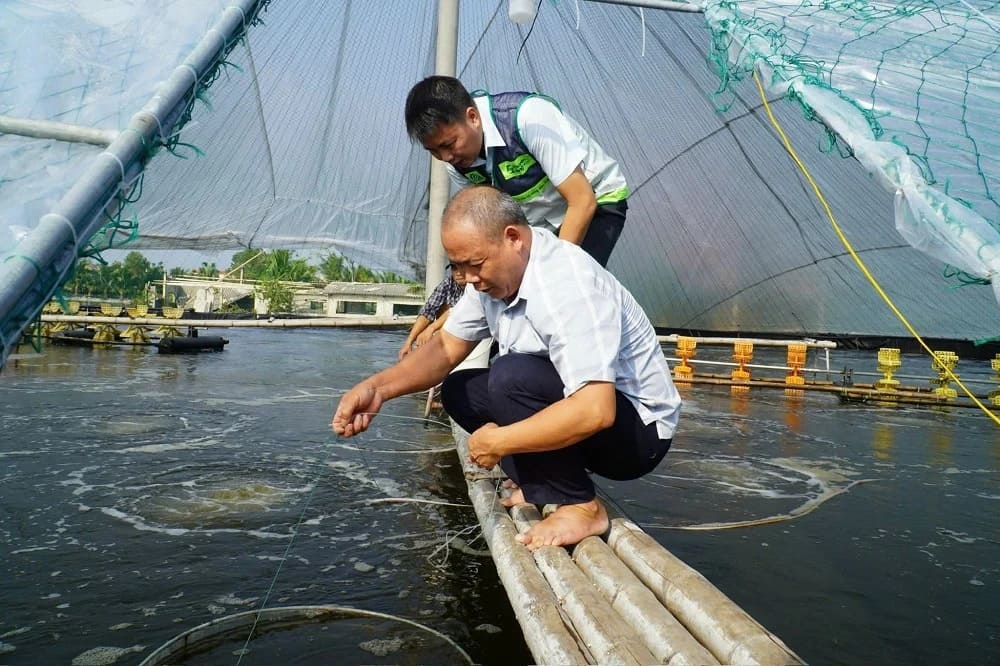
The high-tech shrimp farming model applies a three-stage farming process in net houses, helping to increase the survival rate of shrimp seed and limit disease right from the beginning of the crop. Photo: Thu Thuy.
Currently, together with associated households, Mr. Phuong operates 38 farming ponds on an area of about 5 ha and continues to expand production scale, including building a separate nursery area to proactively supply high-quality shrimp seed.
Shrimp farming following biosecurity orientation, increasing product value
Not only investing in infrastructure, Mr. Phuong also focuses on applying technical advances throughout the farming process. Instead of overusing chemicals and antibiotics, the farm prioritizes the use of microbial products to treat the environment, decompose organic matter and maintain stable water quality.
Environmental parameters are checked and recorded daily for timely adjustment when fluctuations occur. As a result, shrimp grow well, survival rates are high, farming time is shortened while production costs are significantly reduced.

Mr. Le Van Phuong’s shrimp farming model is one of the effective high-tech application examples in the locality, not only improving productivity but also reducing environmental impact and ensuring sustainable development. Photo: Thu Thuy.
Each year, the farm carries out three crops with an output of about 50-70 tons of commercial shrimp. Average revenue reaches about 12 billion VND, with profit after costs reaching nearly 5 billion VND per year. The model also creates regular jobs for about 20 local workers.
According to Mr. Phuong, for high-tech shrimp farming to be effective, farmers need to focus on selecting shrimp seed with clear origin, properly preparing ponds, strictly managing water quality and linking with enterprises to stabilize output.
In addition to production development, he actively shares technical experience with many farming households in the area, contributing to the transition from traditional farming methods to science and technology-based models.
Experts assess: This is one of the effective high-tech application examples in the locality. Synchronous investment from infrastructure to environmental management processes not only improves productivity and product quality but also reduces environmental impact, in line with the orientation of sustainable aquaculture development.
In the context of the aquaculture sector having to adapt to climate change and increasingly high requirements for food quality, Mr. Le Van Phuong’s model shows that the application of science and technology is becoming an important solution to help farmers control risks, increase product value and develop shrimp farming in a modern and sustainable direction.
Source: https://agriculture.vn/

 Tiếng Việt