


Vietnam Seafood
Food safety control for Vietnam’s exported tilapia
24
Aug
Aug
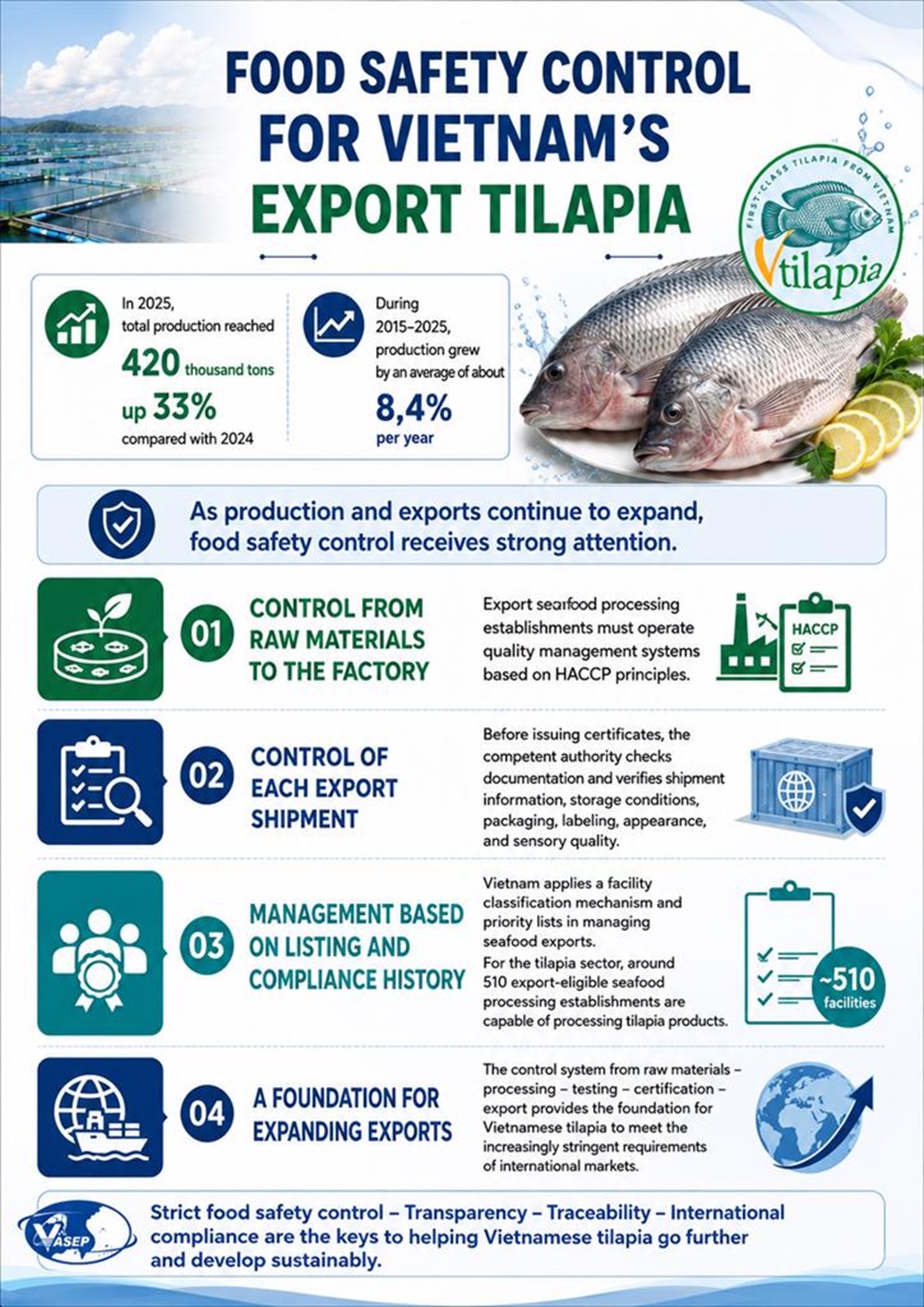
Vietnam’s tilapia industry is maintaining strong growth momentum, with significant room for further expansion in the coming years. In 2025, total tilapia production reached approximately 420,000 tonnes, up 33% from 2024 and 2.2 times higher than in 2015. During 2015–2025, production grew at an average annual rate of around 8.4%. As production and exports continue to expand, food safety control is receiving increasing attention to ensure product quality, meet the increasingly stringent requirements of international markets, and provide a foundation for the sustainable development of Vietnam’s tilapia industry.
Control from Raw Materials to Processing Plants
Exported tilapia is controlled under Vietnam’s seafood food safety management system throughout the supply chain, covering raw materials, processing establishments, export consignments, certificates and feedback from importing markets. The focal authority is the National Agro-Forestry-Fisheries Quality, Processing and Market Development Authority (NAFIQPM) under the Ministry of Agriculture and Environment, together with regional centers responsible for assessment, sampling, testing and certificate issuance.
Seafood processing establishments for export must operate quality management systems based on HACCP principles and meet requirements concerning facilities, equipment, hygiene, water and ice, cross-contamination control, temperature, storage, traceability, labeling and production records.
Competent authorities also inspect records on origin, raw material reception, HACCP systems, food safety monitoring results, alerts, customer feedback and the company’s compliance history. For establishments that fail to meet requirements, corrective actions must be implemented and the facilities reassessed before approval is considered.
For farmed tilapia, controls are also implemented at the production area and raw material level through monitoring programs for residues of harmful substances in farmed aquatic products. This ensures that food safety is controlled not only at processing plants but throughout the entire production chain.
Control of Each Export Consignment
Before an export certificate is issued, competent authorities examine documentation and verify information on the consignment, storage conditions, packaging, labeling, appearance and sensory characteristics. Where required, samples may be collected for laboratory testing once the relevant conditions have been met.
If documentation or storage conditions fail to meet requirements, the inspection process is suspended for the preparation of an official record and appropriate handling. This mechanism helps ensure that only consignments meeting food safety requirements are issued export certificates.
Management Based on Lists and Compliance History
Vietnam applies a classification and priority-list system in the management of exported seafood establishments. Facilities with a good compliance record that are included on approved export lists and fall under the priority category may have certificates issued based on the results of assessments of the effectiveness of their food safety hazard controls. In contrast, establishments outside the priority list must undergo assessment and batch-by-batch sampling and testing before an export certificate is issued.
According to the list updated by NAFIQPM on June 26, 2026, Vietnam had 868 seafood production and trading establishments participating in the Export Seafood Certification Program. Of these, 505 seafood establishments were listed for the EU market and 798 for the South Korean market.
For the tilapia industry, approximately 510 qualified seafood processing establishments eligible for export are capable of participating in the processing of tilapia products.
A Foundation for Expanding Exports
The control system covering raw materials, processing, testing, certification and export provides an important foundation for Vietnam’s tilapia to meet increasingly stringent requirements in international markets.
As tilapia exports continue to expand into the United States, Brazil, Japan and the Middle East, maintaining food safety controls, traceability and compliance with market-specific standards will play an important role in building importer confidence, improving product quality and strengthening the competitiveness of Vietnamese tilapia.
Source: https://seafood.vasep.com.vn/

 Tiếng Việt